

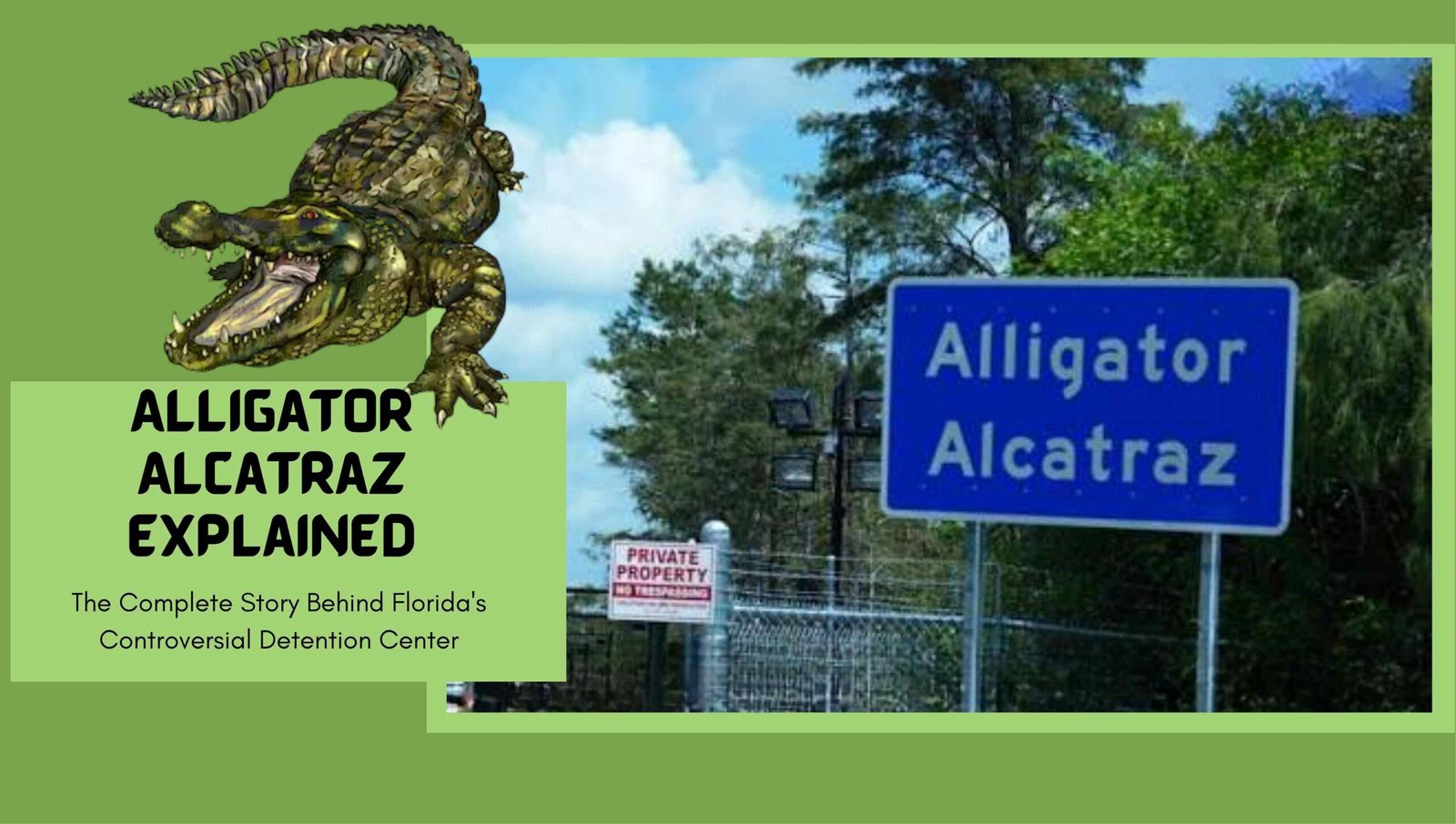
Alligator Alcatraz emerged as one of the most controversial immigration detention centers in the United States. Due to its remote location in the Florida Everglades, political ramifications, environmental impact and human rights discussions. Often referred to as an out of sight-out-of-mind site in the midst of alligator-infested wetlands, it soon gained national attention from government officials, news media and advocacy groups. In this complete guide, find out what Alligator Alcatraz is, Alligator Alcatraz location, project history and flooding issues with legal and environmental controversies also why it closed to current situation.
What Is Alligator Alcatraz
Alligator Alcatraz is the nick name of a temporary immigration detention centre created in the Florida everglades. The name reflects both Florida’s infamous alligator territory and the famous Alcatraz prison, indicating the remote and heavily secured location of the site. The centre was designed to temporarily hold immigration detainees until their cases were settled, they were transferred elsewhere, or deported. While the remote location, environmental implications and alleged conditions of confinement were all ripe for criticism, Alligator Alcatraz has been a lightning rod for political, legal and humanitarian debate nationwide.
| Aspect | Details |
| Official Name | South Florida Detention Facility |
| Nickname | Alligator Alcatraz |
| Type | Immigration detention center |
| Location | Florida Everglades |
| Opening Year | 2025 |
| Status | Closed |
| Purpose | Immigration detention |
| Facility Type | Temporary detention center |
| Region | Southern Florida |
Histor of Alligator Alcatraz
The Alligator Alcatraz Story is rooted in the history of the former Dade-Collier Training and Transition Airport in the Florida Everglades. The story of the site can be traced back to thousands of acres bought by Miami-Dade County in the 1960s when a huge ambitious plan for Everglades Jetport, touted as one of the biggest airports in the world, was under way. Construction began in 1968 but was stopped a year later after a major environmental impact assessment predicted irreversible harm to the Everglades — though only one runway, partially completed, was ever built. More than 50 years later the site was used again in 2025, when it was refitted as a temporary immigration detention centre and quickly gained national attention under the nickname Alligator Alcatraz because of some alligators seen on its outskirts and its isolated location surrounded by Everglades wildlife.
| Year | Event |
| 2025 | Project announced |
| 2025 | Construction completed |
| 2025 | Operations began |
| 2025 | Public controversy increased |
| 2026 | Legal challenges continued |
| 2026 | Closure announced |
Alligator Alcatraz Location
Alligator Alcatraz was located at the abandoned Dade-Collier Training and Transition Airport in the middle of the Florida Everglades, outside Ochopee South Florida. The site is located roughly 50 miles west of Miami on the Tamiami Trail (U.S. Route 41). The secluded spot, blanketed by wetlands and dense vegetation, was selected for its security and limited public access. The location spurred a slew of environmental concerns because some critics claimed the facility could harm one of the nations most fragile ecosystems in close proximity to the Everglades.
Alligator Alcatraz Controversy
Alligator Alcatraz was explicitly designed to be used as a high velocity staging point and punishment center. Its remoteness made it impossible for its advocates to release criminal undocumented people back into their communities because of space constraints. But the plant, from the start, sparked a huge controversy both for humanistic and environmental reasons:
There were serious systematic violations of human rights, including by humanitarian groups, such as Amnesty International. Detainees were denied access to regular legal representation, had incommunicado detention periods, and had to endure the poor sanitary conditions. The frequent breakdowns in the temporary plumbing, presence of worms in the food, constant exposure to insects, and lack of any privacy, such as camera directly over toilet facilities, were reported.
Ecological Ruin:
The camp was built in the middle of one of the most critical ecosystems, and was met with heavy opposition by groups such as Earthjustice. Waste runoff, relentless aircraft noise, and the huge land use footprint were cited as threats to endangered species, including the Florida panther, by activists.
The facility was vehemently opposed by the Miccosukee Tribe of Indians of Florida and other regional Native leaders who saw it as an unwarranted, injurious invasion of their ancestral and sacred lands.
There were high court legal disputes over the facility. Environmental lawyers challenged the quick construction on the grounds that it is in direct conflict with the Clean Water Act and the Endangered Species Act and that it was altering the natural hydrology of the Everglades. As this happens, civil rights law firms filed class-action lawsuits asking for immediate control of the conditions inside the facility, saying it lacked medical care and that conditions inside the tents were “very hot” and that “vulnerable populations” were being kept in isolation for too long.
Is Alligator Alcatraz Still Open
No, Alligator Alcatraz is closed now. The facility ceased all intake, processing and staging operations as of June 2026. The area is a zero detainee zone. With the exception of the runway, the airfield is now clear, as heavy construction equipment and demobilisation teams have been deployed to systematically remove the soft-sided structures, perimeter fences and temporary utilities.
The switch from a busy high security facility to a desolate demolition site was quick, in a matter of weeks. After the last deportation order, the remaining detainees were transferred in a systematic manner to the permanent brick and mortar federal facilities or were processed on deportation flights for final deportations. All of the physical structures have been removed, and only a skeleton staff of guards now patrol the site to keep other people away from the few state buildings that remain.
Alligator Alcatraz Shut Down : Reason
The closure of the facility is final and without any time limit. After several months of growing pressures, the camp finally closed its doors forever on June 25, 2026, with an official announcement issued by state officials.
Financial audits were a real issue in the closure. It turned out that Alligator Alcatraz was, perhaps, the most costly place of immigration detention in U.S. history. Camp operation with no permanent resources, only hauled in resources, temporary generators and emergency staffing costs up to twenty times more taxpayer dollars per detainee than permanent federal detention facilities across the country. The financial burden and the success of environmental groups in litigation over violations of the National Environmental Policy Act (NEPA) brought an end to the operation.
Alligator Alcatraz Flood
Flooding problems became a significant problem at Alligator Alcatraz because the structure was built on top of the low-lying sub-tropic Florida Everglades region known for heavy rainfall and seasonal flooding. Some reports noted build-up at the grounds of parts of the temporary detention site during periods of heavy rain, with questions raised over drainage, hygiene and operational safety. The flooding threat underscored the complications of operating a temporary facility in an ecologically sensitive wetland that is prone to severe weather and tropical storms.
Alligator Alcatraz Merch

At a time when few government enforcement facilities become a cultural icon, Alligator Alcatraz was a big hit, and Alligator Alcatraz merchandise appeared. In the initial stages, politicians were openly joking that the surrounding alligator population was an effective natural guard force to help keep the animals in check and prevent escapes.
The White House and political allies had them manufactured in themed items to make good use of the national media coverage. This included T-shirts, hats and collectibles challenge coins with “Alligator Alcatraz” and stylized alligator motifs. The goods were popular with supporters as a hardline border enforcement symbol, but were criticized by humanitarian organizations, which saw the item as an “embarrassment” and a “business of the human suffering.”After the facility closed, these items have become controversial political collectibles.
Florida Government: Florida Governor
Florida Governor Ron DeSantis spearheaded the initiative to establish, quickly deploy and eventually protect Alligator Alcatraz. DeSantis, who was working closely with the state Attorney General, James Uthmeier, was permitted to use executive emergency powers to take over the county-owned airfield, and to ensure millions in state funds were allocated for the camp construction.
Governor DeSantis’ demeanor was buoyant at the end of the day when he held the last press conference to close the site. He said that Alligator Alcatraz was able to keep to its emergency mandate of providing a buffer during a high priority enforcement push and stated it was successful. He said that it was the facility’s success in clearing thousands of dangerous people from the public communities ahead of the federal government’s permanent beds taking up the slack.
The project has continued to have a political ripple effect on the state government, helped solidify the Governor’s standing with conservative voters as a “border security leader,” but it also garnered significant criticism from fiscal conservatives who worried about the massive amount of funds that state taxpayers paid for a short-lived facility. The project has been a major concern of those pushing back against emergency funding and state-level executive overreach.
Conclusion
Alligator Alcatraz remains one of the most controversial immigration prisons in recent American history. Established in 2025 at a former Dade-Collier Training and Transition Airport site in the Florida Everglades, it garnered national attention due to its remote location, environmental concerns, legal hurdles and humanitarian issues. The facility has since closed, but remains relevant on the national stage in debates about immigration policy, detainee rights, government spending and environmental protection. More importantly its story reveals a fraught balance between securing U.S. borders, assuring public order and protecting one of America’s most fragile ecosystems.
FAQs
Alligator Alcatraz is an old immigration detention center in the Florida Everglades, USA.
It is situated close to the town of Ochopee in south Florida, in the Everglades.
No, it has shut down.
Some flooding and water accumulation was reported as a concern due to the wetland site.
There were criticisms about the environmental aspects, conditions for the residents, legal access, and operation costs of the facility.
Also Read: Inside Israel: History, Politics, Iran Conflict and Latest News
Enhancing Vision for Active Lifestyles: Exploring EVO ICL Lens
