

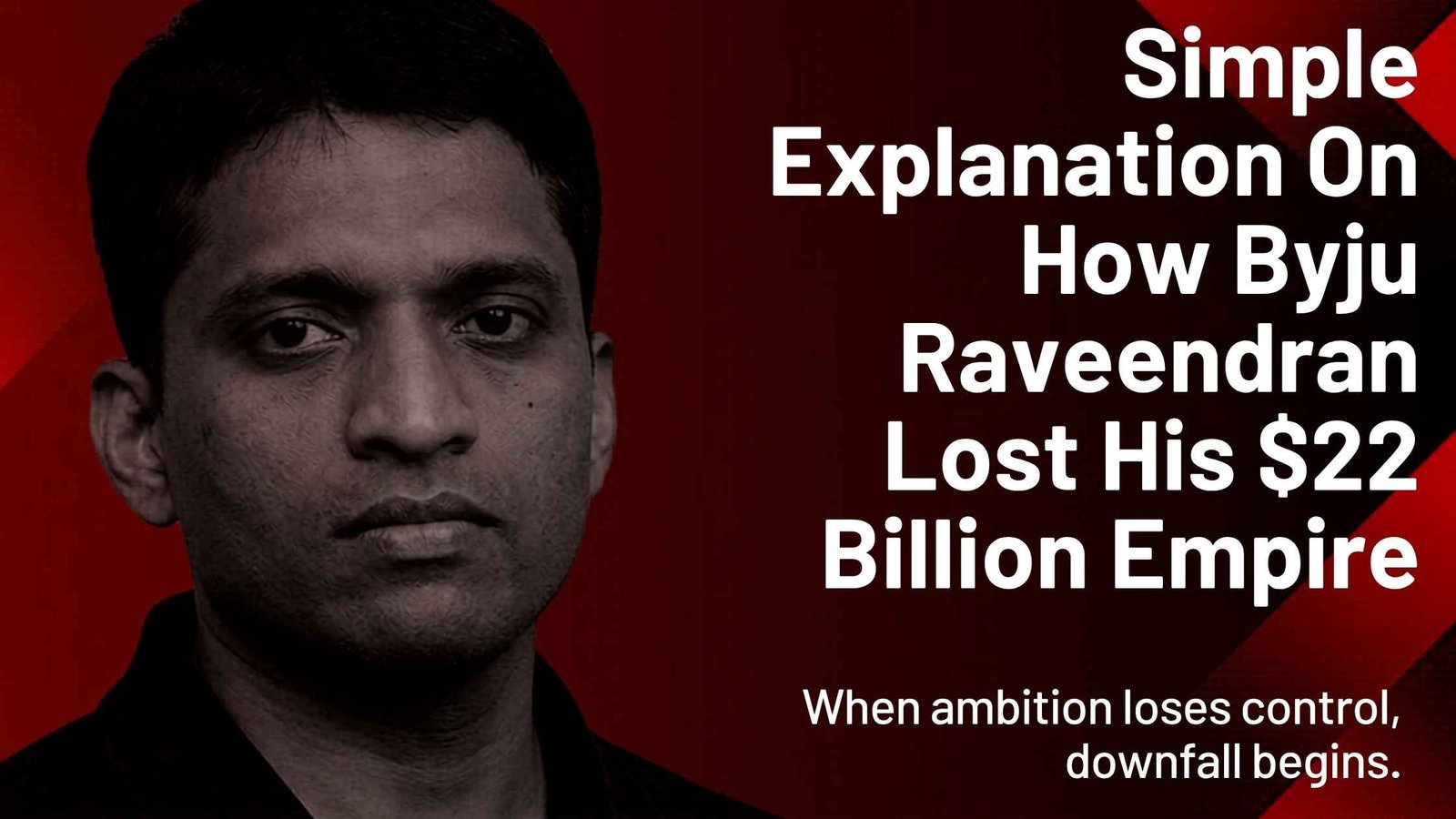
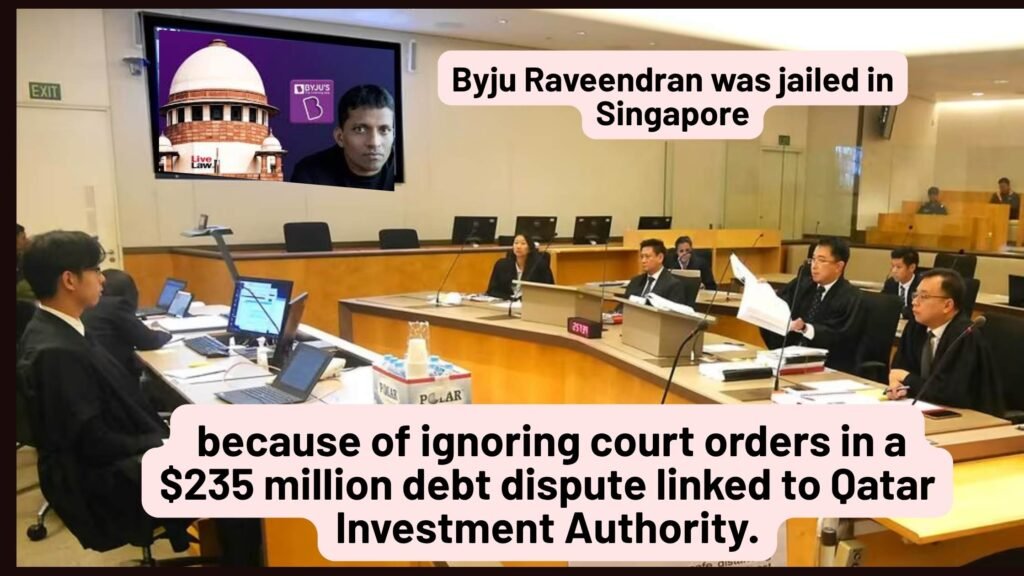
The once-heralded founder of India’s biggest edtech company BYJU’S, Raveendran has been sentenced to six months jail for contempt of court by a Singapore court. Reported by Bloomberg on May 27, 2026, the ruling is one of the most significant and shocking declines in the history of Indian startups, making an individual who once opened the doors of opportunity for millions of students, a fugitive-like figure pursued across three continents.
The court ordered Raveendran to “deliver” himself to authorities and also pay legal fees of $90,000 (about USD 66,000) and hand over documents of his ownership of a corporation called Beeaar Investco Pte, which owns shares in a related company. A subsidiary of Qatar Investment Authority started the proceedings after investing in BYJU’S during one of its most turbulent restructuring phases.
But the verdict was challenged by Raveendran. The ruling was procedural in nature and he said he did no wrong, he said. Moreover, he said, discussions with lenders, GLAS Trust and QIA in particular, regarding the settlement are nearing an end, and he would appeal the order. Given the background, the recent move by QIA to press on this issue looks like an unnecessary pressure tactic at this juncture in the settlement process, he said in a public statement.
From the classroom to the Unicorn: The story of BYJU’S
It’s important to reflect on how Byju Raveendran got here to understand how he got here. Raveendran grew up in a family of teachers in Kerala, and started teaching engineering aspirants in Bengaluru in the early 2000s. He had a highly innovative approach to teaching, was very energetic and visual — and students enjoyed it. In 2011, he started to think and learn private limited (now the parent company of BYJU’S).
Read About: BYJU RAVEENDRAN
BYJU’S expanded at an astounding rate over the past decade. The platform integrated video learning with adaptive technology to tailor learning to the students across grade and competitive exam categories. Foreign direct investment of over Rs 28,000 crore has been received by the company since 2011. When BYJU’S was valued at USD 22 billion, it was India’s most valuable startup, and was one of the most valuable edtech companies in the world.
Besides, Raveendran took a chance on some products, which were not his area of expertise. The company has recently caught up with a couple of other platforms namely Aakash Educational Services, Toppr, WhiteHat Jr and others. These mergers broadened the brand’s reach – and also added a great deal to its cost base as well.
As the cracks in the walls began to appear.
The Covid-19 pandemic initially boosted BYJU’S as school closures across India drove students toward online learning. However, after the pandemic, schools reopened, student interest declined, and the company failed to meet the revenue expectations behind its acquisitions. As a result, BYJU’S laid off employees through multiple rounds of job cuts in 2022 and 2023.
But it was in the meantime that there was a growing issue with governance. The company had faced a series of delays in submitting its financial statements, which were subject to an audit, and had drawn the attention of investors and regulators.The company repeatedly delayed submitting its audited financial statements, prompting inquiries from investors and regulators.
Multiple board members, high-profile representatives of key investor groups, stepped down. Financial accounts for 2020-21 have not been submitted for an extended period of time, further raising concerns around transparency.
The Enforcement Directorate (ED) on 28 April 2023, conducted a raid on the office premises of BYJU’S and the home of Raveendran in Bengaluru. The agency had said it had found incriminating documents and digital data, and alleged violations of the Foreign Exchange Management Act (FEMA). Subsequently, in November 2023, the ED issued a formal show cause notice against FEMA for alleged violations of the regulations for delayed FDI filings, failure to allot shares and also for the improper handling of foreign remittance, worth Rs 9,362.35 crore.
A Storm Across Three Jurisdictions
The legal onslaught on Raveendran was not limited to India. The group of international lenders, who had extended a USD 1.2 billion term loan B to BYJU’S, claimed that the company had committed to repayments, but mismanaged the loan amount in the United States. BYJU’s Alpha, the company’s financing entity in the United States, filed for Chapter 11 bankruptcy protection in Delaware. In these proceedings, a Delaware bankruptcy court sanctioned Raveendran for the failure to appear and produce documents and to obey discovery orders. He was liable to a fine of USD 10,000 a day.
In November 2025, the Delaware court issued a jaw-dropping default judgment of more than USD 1.07 billion against Raveendran himself in the context of fraudulent transfers and concealing USD 533 million in funds. In December 2025, the court overturned the monetary damages award, when it considered a motion filed by the lawyers for Raveendran. The court found that the damages calculation was improper and ordered a fresh trial to reassess the damages.
In 2025, the Dubai International Financial Centre (DIFC) court gave decisions against Raveendran. The DIFC court ordered him and his wife to pay adjournment costs of more than USD 195,000. Raveendran later said he was not present at the UAE hearing, even though the Dubai hearing had earlier been cited as the reason for missing the US court hearing.
Explore the events after the BCCI went bankrupt.
It was an even more dramatic scene back in India in the month of July 2024. The National Company Law Tribunal (NCLT) has accepted the application of Think and Learn Private Limited – the parent company of BYJU’S – into the Corporate Insolvency Resolution Process (CIRP).
The Board of Control for Cricket in India filed the petition alleging unpaid dues of Rs 158 crore, and after the NCLT admitted the case, an insolvency resolution professional took control of the company from its founders.
As of October 2024, Raveendran admitted that Raveendran valuations have sunk to zero. Customers filed more than 4,390 unresolved complaints against the company, valued at USD 22 billion, and sued it across various legal forums.
Settlement Is Near – Raveendran Responds
However, in public statements, Raveendran has continued to be optimistic, even in the wake of the Singapore sentencing. He says a comprehensive deal with the lenders and investors is just around the corner. His lawyers have also said that GLAS Trust and other lenders failed or misrepresented crucial information in the proceedings which helped bring enterprise value to its knees. It will be interesting to see if these arguments carry with them to appeals.
Whether Raveendran was physically in Singapore at the sentencing time is not clear. But the instructions from the Singapore court to hand over, however, indicate that the authorities have faith that he will comply. To date, there has been no confirmation of surrender.
The Singapore verdict is another move in a sprawling multi-jurisdictional legal battle, which has taken place in India, the U.S., Dubai and now Singapore. The BYJU’S debacle is a cautionary story for the edtech industry as a whole on the risks of unchecked growth, opaque leadership and over-leveraged expansion.
FAQs
A Singapore court sentenced Byju Raveendran to six months in prison for contempt of court.
His failure to follow several court orders regarding disclosure of his assets is behind the ruling. The case had been opened by a company of the Qatar Investment Authority.
BYJU’S ascended into the highest valuation of USD 22 billion, making it India’s most valuable start-up and one of the most valuable edtech companies in the world. But Byju Raveendran himself admitted in October 2024 that Byju’s valuation was now at zero.
The Enforcement Directorate had claimed Rs 9362.35 crore losses due to FEMA violations by Think and Learn Private Limited and Byju Raveendran. The allegations were out of the FDI filing time, not allotting shares for foreign investments and irregularity in foreign remittance processing.
The NCLT had admitted the parent company of BYJU’S, in July 2024, after receiving a petition by the BCCI for Rs 158 crore dues. The NCLT appointed an insolvency resolution professional and removed the founders from control of the company.
Yes. Byju Raveendran has said that he has made plans to appeal the court order issued by the Singaporean court. He described the ruling as procedural, denied any wrongdoing, and said he is in advanced settlement talks with creditors including Qatar Investment Authority and GLAS Trust.
