

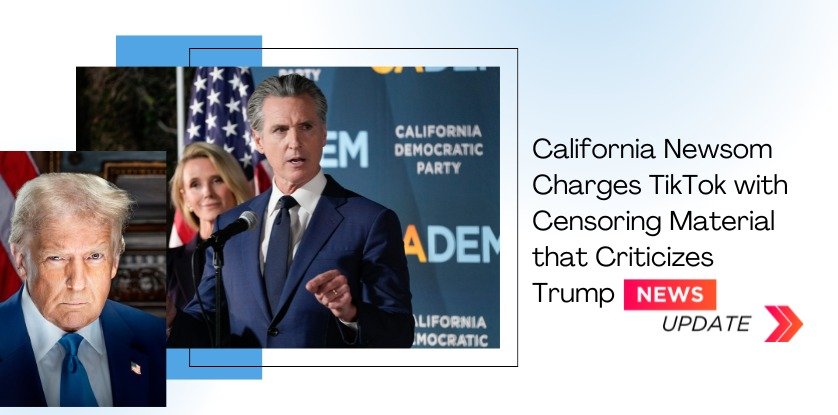
Newsom, in his unorthodox action, which has sparked new controversies on social media transparency, accuses TikTok of burying content that leads to a negative view of Trump, and this is another step on the list of scrutiny of big tech platforms. On January 27, 2026, Governor Gavin Newsom went to social media and stated that the popular video-sharing platform is intentionally suppressing the dissemination of posts that are critical of former President Donald Trump. This charge appears at a very timely moment when concerns over content moderation, algorithm bias, and the role of social media sites to drive the discourse of the masses are more than ever. The accusations have created an extensive debate on whether TikTok is politically censoring or just implementing its community policies. Being one of the most influential Democratic voices in the country, Newsom’s assertions are taken seriously and may potentially change the discourse on the accountability of social media platforms.
The Controversies: What Newsom said
The Core Accusations
The claims of Governor Newsom revolve around the scenario of what he terms the deliberate prohibition of information that criticizes Trump on TikTok. In his words, videos and posts that challenge or criticize the policies, actions, and statements of Trump seem to have much less visibility when compared to neutral or supportive ones. According to the California governor, this trend proves that there is an intention to manipulate the algorithms instead of distributing the content randomly.
Evidence Presented
Even though Newsom is not ready to offer detailed data to prove his argument, he has cited various cases in which:
- The videos of political commentaries that criticized Trump had abnormally low engagement rates.
- Creators of the content complained that they lost their audience in a flash when they published criticism of Trump.
- Other platforms with similar content were greatly more reachable.
- Reporting of shadow-banning of certain political content by users.
TikTok’s Response
TikTok has strongly refuted these claims, asserting that it has content moderation rules that do not discriminate against politics. The platform has focused on the fact that they were committed to neutral content moderation and had hinted that differences in engagement may be a result of several factors, which include: user behavior, time of posting, and quality of content, as opposed to political bias.
Bigger Picture of Social Media Censorship
Concerns in the Past regarding Bias in platforms
It is not the first accusation that the large social media platforms put forward in terms of political bias. Over the past several years:
- Twitter (since renamed X) was also under the microscope on both political sides on content moderation.
- Depending on the critic, Facebook has been accused of both liberal and conservative bias.
- YouTube has had to deal with accusations of censoring some political opinions.
- Several platforms have been grappling with the concept of free speech and hate speech.
The TikTok Politics Scandal
TikTok has a niche in this terrain because of its:
- Parent companyByteDance, which is owned by the Chinese.
- A vast presence of influence among younger groups.
- Algorithms to decide what to show and to which ones are opaque.
- Past scandals of privacy of data and national security.
Why This Is Important: Democracy Implications
The strength of Social Media Plates
The contemporary political narrative is occurring more than ever on social media sites, with the content moderation policy becoming paramount in the democracy. When platforms are able to control what millions of people watch or not, they have colossal power over:
- Public opinion formation
- Effectiveness in a political campaign.
- Availability of various opinions.
- Democratic involvement and participation.
Transparency Concerns
The main problem described by Newsom is that the majority of social media algorithms are black boxes, and people have little knowledge and control over how content is distributed. Such a lack of transparency generates a setting in which:
- Cries of bias are hard to counter or to prove.
- Customers do not know why some content is targeted to them.
- It becomes easy to do the political manipulation without being spotted.
- Accountability among platform providers is poor.
Dimensions of National Security
Since TikTok is owned by the Chinese, other analysts have also expressed further issues that concern foreign control could be influencing content moderation decisions. Although it cannot be stated with certainty that the security threat has been interfered with, it is a subject of investigation by the U.S. authorities.
The Content Distribution on TikTok and Its Algorithm
The Recommendation System
The algorithm used on the For You Page (FYP) of TikTok delivers content to the users based on:
- History of interaction with the user (likes, shares, comments)
- Video data (captures, sounds, hashtags)
- Device and account settings
- Freshness of content and trending.
Potential Bias Points
According to critics, Tik Tok bias in the algorithms may happen at various levels:
- Content classification – Classification of posts.
- Engagement weighting – What kinds of interactions are the most important ones?
- Visibility throttling – restricting the distribution of some types of content.
- Shadow-banning – Giving creators a low-reckoning.
What TikTok Claims
The platform insists that its algorithm puts a premium on:
- The quality and originality of the contents.
- Safety for the users and adherence to community guidelines.
- Real interaction as opposed to fake control.
- Various content is exposed to the users.
Political Responses and Specialist Views
Arguments in Favor of the Position of Newsom
Various digital rights advocates and progressive politicians have contended in favor of looking into the claims made by Newsom, saying that:
- Democratic health needs platform accountability.
- Social media algorithms should also be required to be audited by independent auditors.
- Customers should have access to the information on the content moderation decisions.
- Others to be scrutinized include foreign-owned platforms.
Skeptical Voices
Others have doubtfully asked about the charges, arguing:
- Absence of detailed statistical data.
- Other possible ways to explain engagement patterns.
- Probable political reasons for the accusations.
- Inability to reliably identify bias and typical algorithmic deviation.
Technology Experts Weigh In
Researchers of social media have observed that it is very difficult to prove the existence of algorithmic bias due to the following reasons:
- There is a continuous development of algorithms.
- There are several variables that influence content performance.
- Correlation does not mean causation.
- Data on platforms is seldom available to be analyzed separately.
The Implications of this to Content Creation and Consumers
Political Content Creators
In case the claims by Newsom turn out to be true, creators who create content criticizing Trump may have to:
- Multiplex on various platforms.
- Establish a direct relationship with the audience on non-social media.
- Patterns of engagement on documents as evidence.
- Optimize content policies on a platform basis.
For Average Users
The average user of TikTok should take into account:
- Asking different information sources other than individual platforms.
- Realizing that they are fed on algorithms.
- It is important to be aware of their possible blind spots in their content exposure.
- On the side of calls to enhance the transparency of the platform.
Platform Responsibility
The scandal highlights the necessity of such apps as TikTok to:
- Explain the policies on content moderation better.
- Present the transparency report with comprehensive engagement information.
- Be subject to autonomous algorithmic audits.
- Act productively on matters of legitimate prejudice.
Legal and Regulatory Implications
Existing Regulatory Framework
By the beginning of 2026, social media sites will be regulated by the federal government concerning content regulation at a low level. Nevertheless, various suggestions are going to enhance the accountability of the social media platforms:
- The law on platform transparency.
- Automated audit requirements.
- Protections on user data rights.
- Restrictions on foreign ownership.
California Potential Action
Since the state of California has a history of being at the forefront of technology regulation, the state of Newsom can potentially:
- Bring formal inquiries into the activities of TikTok.
- Demand more transparency from platforms that are operating in California.
- Introduce state-level content moderation control.
- Work in cooperation with other states.
Federal Considerations
The accusations can also affect the current federal debates concerning:
- The survival of TikTok in the US.
- Greater social media control.
- Foreign-owned platforms are under review to identify their national security.
- Standards of content moderation on all asymmetries.
The comparison between TikTok and Other Social Media Platforms
| Platform | Ownership | Transparency Level | Political Content Policies | Audit Availability |
| TikTok | ByteDance (China) | Limited | Community guidelines-based | No independent audits |
| Facebook/Instagram | Meta (USA) | Moderate | Oversight Board review system | Limited third-party access |
| X (Twitter) | Private (USA) | Variable | Community Notes approach | Some API access |
| YouTube | Google (USA) | Moderate | Advertiser-friendly guidelines | Limited researcher access |
| Microsoft (USA) | Moderate | Professional content focus | Minimal external review |
The Way Forward: The need to deal with transparency issues
What Needs to Happen
To eliminate such scandals, specialists recommend some measures:
- Algorithms: Independent Algorithmic Audits
- Anonymized data should be made available to third-party researchers.
- Periodic public announcements of patterns of content distribution.
- Definite measures of possible bias.
- Increased Transparency Reporting
- In-depth content moderation decision breakages.
- Reach and engagement by content category statistics.
- Algorithms and description of their changes and effects.
- User Empowerment Tools
- Alternatives to viewing suggestions as to why certain material was suggested.
- Moderations of algorithmic preferences.
- Procedures to have moderation decisions clearly appealed.
- Regulatory Oversight
- The government agencies that have the technical skills to test platforms.
- Transparency and accountability are standards that can be enforced.
- Penalties to platforms that practice undisclosed bias.
Conclusion
The Newsom of California is accusing TikTok of censoring material that criticizes Trump, which is the beginning of a critical discussion of the issues of social media transparency, accountability in algorithms, and the significance of platforms as determinants of political discourse. Whether these particular accusations are true or not, they demonstrate how the use of social media companies to control and publish content could use more regulation. With the ever more digitalized information environment, the aspect of platforms being run fairly and transparently is not only a question of politics, but is necessary to the health of democracies and informed citizenship.
FAQs
Q – What was it that Governor Newsom accused TikTok of doing?
A – The allegation brought against TikTok by Newsome was that the company routinely removes or hides content criticizing former President Trump, or this is how it algorithmically suppresses the distribution of such content, favoring neutral or supportive content instead.
Q – Is TikTok shown to censor political speech?
A – There is no conclusive evidence that has been brought forth. TikTok disapproves of the accusations, and a careful investigation of the topic by outsourcing companies would be required to verify the presence of systematic suppression. The platform boasts of being non-political in its algorithm.
Q – What is the relevance of Tik Tok into being Chinese owned into these allegations?
A – The parent company of TikTok, ByteDance,e, is located in China, and there is concern that it may be being influenced by foreign forces to moderate its content. Others are concerned that there is a possibility of geopolitics influencing what material is promoted or not, but no interference by the Chinese government has been established.
Q – Is it possible to know whether users are being censored on TikTok?
A – Individual users would be hard-pressed to show chain-of-command suppression. Some of the common reasons why people can engage differently include the posting time, the quality of the material posted, audience actions, and trending topics. To recognize systematic bias, patterns would have to be examined in large numbers of accounts.
Q – How can social media sites be made unbiased?
A – The measures that can be taken involve compulsory independent algorithmic audits, improved transparency reporting, access to the content distribution explanations by users, regulation with enforcement capabilities, and platform responsibilities that involve fines against undisclosed bias.
